Propagating Succulents: Leaf vs. Stem Cutting Protocols for Echeveria, Jade, and Aloe
The Physiology Behind the Split
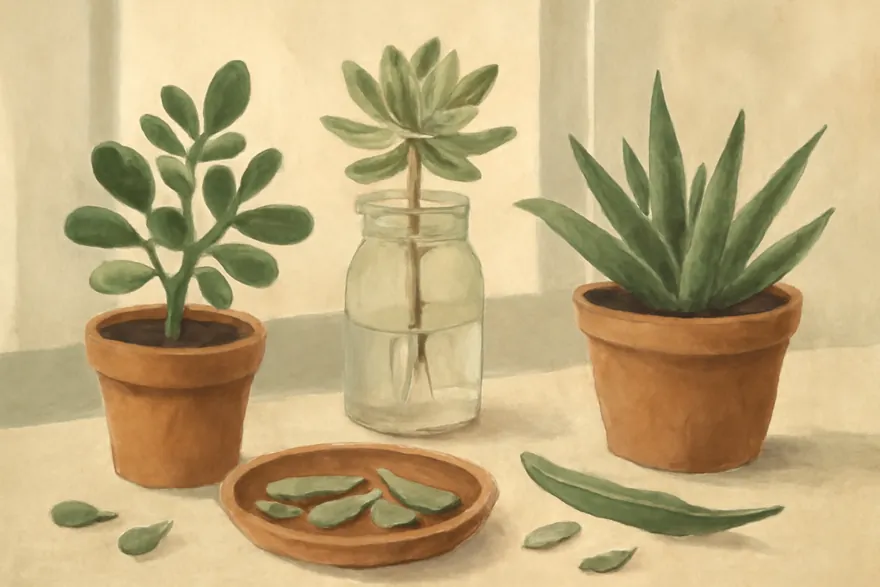
Leaf cuttings and stem cuttings are not interchangeable techniques applied to different plant shapes — they recruit entirely different tissue to do the work. A stem cutting already carries at least one axillary or apical meristem: a cluster of undifferentiated cells that only has to grow roots to become a self-sufficient plant. A leaf cutting has no such head start. It must generate an adventitious root meristem and a new shoot meristem from parenchyma cells clustered at the leaf's point of attachment, essentially building a plant from scratch. That single difference explains almost every propagation quirk covered below: why leaf cuttings take two to four times longer to produce a visible plantlet, why a torn leaf base almost never propagates, and why Aloe — a monocot with comparatively little meristematic reserve in its leaf tissue — barely propagates from leaves at all.
It also explains the purpose of callusing. The wound at a cutting's base is dead and open until the plant seals it with suberin and a corky layer of cells. Skip that step and soil moisture wicks straight into vascular tissue, inviting Fusarium and soft-rot bacteria before any root can form. Callus too long, past the point the wound has sealed, and the cutting simply sits there losing water reserves it needs for the root flush. Timing the callus window to the genus and the cut is the actual skill; "a few days in a dry spot" is the average of several very different numbers.
Echeveria: The Leaf-Pull Protocol
Echeveria is the genus leaf propagation was built for, and success rates on healthy, non-hybridized species commonly run 85–95% per leaf.
- Select a plump, unblemished leaf from the lower third of the rosette — older leaves near the base carry more stored energy than young leaves near the crown.
- Grip the leaf close to the stem and rock it gently side to side, then pull straight out. It must separate cleanly with the small heel of tissue at the base intact; a leaf that snaps midway, leaving a torn stub on the stem, will not root. Discard it rather than trying to save it.
- Lay the leaf on its side — do not stand it upright or bury the cut end — on dry perlite, coco coir, or a paper towel, in bright indirect light with no direct sun.
- Do not water for 2–4 days. This is the callus window: the wound visibly dries and slightly recesses. Misting here is the single most common cause of leaf rot in beginner attempts.
- After the callus period, mist lightly every 2–3 days. Fine root hairs typically appear at the base by day 10–14.
- A tiny pink or green plantlet forms at the base over the following 3–4 weeks, drawing down the mother leaf's stored water and turgor as it grows.
- Do not detach or discard the original leaf until it has fully shriveled and turned translucent-papery. Removing it early cuts off the pup's food supply and stalls or kills it.
Hybrids with thin, narrow-attachment leaves — many Echeveria x Sedum and Graptopetalum crosses — detach less cleanly and propagate at closer to 50% success. If a variety consistently snaps rather than pulls free, switch to stem cuttings from a beheaded rosette instead: cut the crown with an inch of bare stem, callus only 1–3 days (the exposed stem tissue is thinner and seals faster than a leaf base), then set it on soil. Offsets ("chicks") that form along that bare stem afterward can be treated as new leaf-pull candidates.
Jade (Crassula ovata): Stem-First, Leaf as a Slow Backup
Jade roots readily from stem cuttings and far less reliably from leaves, which makes it a useful contrast to Echeveria.
Stem cuttings
- Cut a 3–4 inch tip with at least two leaf nodes, using a clean blade wiped with isopropyl alcohol between cuts to avoid transferring rot pathogens between plants.
- Strip the lowest pair of leaves so no foliage sits below the soil line.
- Callus in open air, out of direct sun, for 3–7 days. The cut surface should visibly dry, dull, and seal to a tan or grey rim before you proceed — thicker, older woody stems can take up to 10 days.
- Insert about 1 inch into barely damp cactus mix and withhold water entirely for the first week.
- Roots typically form in 2–3 weeks; test by a very gentle tug — resistance means anchoring roots are present.
Leaf cuttings
A single healthy leaf, twisted off with a clean base, can be pressed cut-end down onto (not into) the soil surface. Callus for 5–7 days before any misting. Roots emerge in 3–4 weeks and a visible plantlet takes 6–8 weeks, roughly double the stem-cutting timeline, with success rates closer to 60–70% rather than the 85–95% typical of stem cuttings. Variegated jade often reverts to solid green from leaf cuttings, so propagate variegated stock from stem cuttings only if holding the variegation matters.
Aloe: Why Leaf Cuttings Fail and Offsets Take Over
This is the genus-specific caveat worth stating plainly: Aloe leaves cut and planted almost always rot rather than root. As a monocot, Aloe lacks the ring of meristematic parenchyma that succulent dicots like Echeveria and Crassula carry at the leaf base, so there is no tissue reservoir available to regenerate a new plant. Any propagation guide that describes "Aloe leaf cuttings" without this caveat is describing a method with a near-zero success rate.
Aloe propagation instead relies on offsets ("pups") that form naturally at the base of a mature rosette:
- Wait until a pup has at least 3–4 leaves and is roughly 2 inches across before removing it — smaller pups are frequently still attached to the parent's root system for water and separating them too early causes desiccation.
- Use a clean, sharp knife to sever the pup at its natural narrow attachment point to the parent, keeping any of its own roots intact wherever possible.
- Callus the wound before planting: 2–4 days for a small cut under an inch across, but 5–10 days for a larger wound over an inch — the callus period scales with wound diameter far more than with genus in this case.
- Plant in a gritty, fast-draining mix and withhold water for 7–10 days after planting, then begin light watering.
One exception is worth noting: prolific pupping species like Aloe vera often produce offsets that already carry their own root system at separation. When visible roots are already present, skip the extended dry-callus period and water lightly right away — the plant is not relying on a sealed wound to survive, it already has functioning roots.
Callusing Times at a Glance, and Where Cuttings Actually Fail
- Echeveria leaf-pull: 2–4 days
- Echeveria beheaded rosette stem: 1–3 days
- Jade stem cutting: 3–7 days (up to 10 for thick, woody stems)
- Jade leaf cutting: 5–7 days
- Aloe offset, small wound (under 1 inch): 2–4 days
- Aloe offset, large wound (over 1 inch): 5–10 days
Most failures trace to one of three causes rather than to bad luck. Rot from an undercallused wound is the most common: soil moisture reaches live vascular tissue before it has sealed. Rot from overwatering before roots exist is the second: a cutting with no roots cannot take up water, so excess moisture simply sits against the base. The third is dehydration from too much airflow or direct sun during the callus stage, which can shrivel a leaf or stem past the point it has enough stored water to fund root growth. Keep callusing cuttings at 70–80°F in bright but indirect light, use a sterile blade between cuts, and resist the urge to check for roots by tugging more than once a week — every disturbance resets a fragile new root's grip on the substrate.
Quick comparison table for: Propagating Succulents: Leaf vs. Stem Cutting Protocols for Echeveria, Jade, and Aloe
| Section | What to check | How to use it |
|---|---|---|
| The Physiology Behind the Split | Match the conditions and warning signs in this section | Use as a quick practical checklist |
| Echeveria: The Leaf-Pull Protocol | Match the conditions and warning signs in this section | Use as a quick practical checklist |
| Jade (Crassula ovata): Stem-First, Leaf as a Slow Backup | Match the conditions and warning signs in this section | Use as a quick practical checklist |
| Stem cuttings | Match the conditions and warning signs in this section | Use as a quick practical checklist |
Questions and answers
Why does a single generic callus-and-plant rule fail across different succulents?
The success of callusing depends on tissue type. Leaf cuttings must form a new root and shoot meristem from the leaf base, so they usually need longer recovery windows, while stem cuttings already include axillary or apical meristem and mainly need to grow roots. If the wound is planted too early, moisture reaches live tissue before sealing and rot starts; if callusing is too long, the piece loses stored water before root flush.
Which propagation method is reliable for Aloe, and what is the first key check before removing a pup?
Aloe propagation should rely on offsets (pups), because Aloe leaves almost always rot and have near-zero success when used as leaf cuttings. Wait until a pup has 3-4 leaves and is about 2 inches across before removal, because smaller pups are often still tied to the parent for water and can dehydrate if separated too early.