Cloning Fruit Trees: Air Layering vs. Grafting Rootstocks for Genetic Fidelity and Disease Resistance
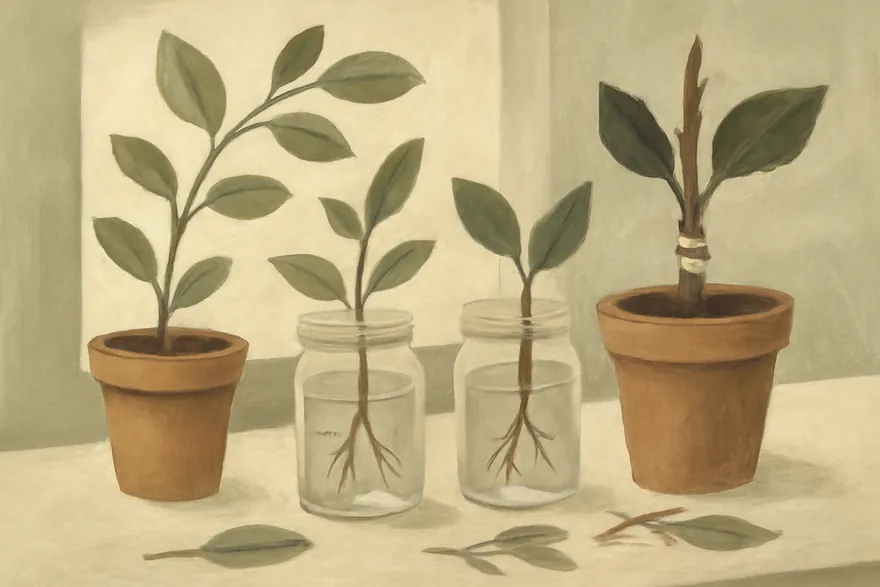
Two Ways to Copy a Cultivar, Two Different Genomes Underneath
Fruit growers use the word "clone" loosely, but air layering and grafting preserve genetic identity in fundamentally different ways. An air-layered tree is a true clone from root tip to shoot tip: every cell traces back to the same mother plant, so there is no second genome anywhere in the system. A grafted tree is a deliberate chimera. The scion above the graft union is genetically identical to the source cultivar, but the rootstock below it is a separate individual, either a seedling or, more often in modern orchards, a clonally propagated selection with its own name and breeding history. That rootstock genome controls vigor, anchorage, cold hardiness at the crown, and, critically, resistance to soil-borne disease and pests.
This distinction matters for orchard planning because "genetic fidelity" is ambiguous unless you specify fidelity of what. Air layering guarantees fidelity of the whole organism, including its native root architecture and any disease susceptibility that goes with it. Grafting guarantees fidelity of fruit, flower, and foliage traits carried in the scion, while deliberately substituting a different, engineered set of root genetics underneath.
Air Layering: Building an Own-Root Clone in the Canopy
Air layering (marcotting) roots a stem while it is still attached to the parent, then severs the new plant once its own root system is established. The procedure is consistent across species:
- Select semi-hardwood growth one to two seasons old, pencil-thick to thumb-thick; current-season soft shoots rot before they root.
- Girdle a 2.5 to 4 centimeter ring of bark and scrape the cambium down to bare xylem, removing every trace of green tissue so the phloem cannot bridge the wound.
- Dust or dip the upper cut edge in IBA (indole-3-butyric acid) rooting hormone at 3,000 to 8,000 ppm for woody species; because the girdle blocks downward phloem transport, sugars and auxins accumulate above the cut, which is exactly where roots need to initiate.
- Pack moistened, squeezed-out sphagnum moss around the wound, wrap tightly in clear or black plastic film, and tie off both ends so moisture cannot escape or rain get in.
- Check the moss ball for a visible root mass before cutting: a translucent wrap lets you inspect without disturbing the graft; opaque wraps require a gentle peek at the tie-off points.
- Sever the rooted layer just below the new root mass, pot it in a free-draining mix, and keep it shaded and humid for two to three weeks while it adjusts to functioning on its own roots.
Rooting speed and success rate vary sharply by species. Fig and pomegranate typically root in four to six weeks with 70 to 90 percent success. Guava responds almost as readily. Citrus species such as lemon and kumquat need eight to twelve weeks and land closer to 60 to 80 percent. Apple, pear, and most stone fruit (Malus, Pyrus, Prunus) root poorly even with hormone treatment, often under 20 percent and only on juvenile wood, which is precisely why pome and stone fruit orchards are propagated almost exclusively by grafting rather than layering.
The honest caveat: an own-root tree from air layering carries no protection beyond whatever resistance the cultivar itself happens to have. An own-root apple, for instance, lacks the woolly apple aphid resistance bred into MM106 and MM111 rootstocks, has no dwarfing control, and is fully exposed to whatever Phytophthora species or nematode population lives in that soil. Own-root cloning trades disease defense for total genetic purity of the whole plant.
Grafting onto Selected Rootstocks: Trading Root Genetics for Engineered Resistance
Grafting joins a scion of the desired cultivar to a rootstock chosen for what it does underground. Whip-and-tongue grafting is standard for dormant-season bench grafting; chip budding suits late-summer propagation when bark is not slipping; cleft grafting is used to topwork mature trees to a new cultivar. In every case, cambium layers on at least one side of the union must align, and success runs 85 to 95 percent for compatible combinations grafted at the right time of year with clean, sharp cuts.
Rootstock selection is where disease resistance is actually engineered into an orchard, not left to chance:
- Apple: the Geneva series (G.41, G.935, G.214), bred at Cornell, targets fire blight resistance and tolerance to apple replant disease; the older Malling-Merton series (MM106, MM111) was bred specifically for woolly apple aphid resistance; dwarfing M9 gives excellent size control but is susceptible to fire blight and collar rot, so it needs careful site matching rather than blanket use.
- Stone fruit (Prunus): Krymsk 86 and Marianna 2624 tolerate wet, heavy, poorly-drained soils and show partial Phytophthora root rot tolerance where standard peach seedling rootstocks like Lovell would fail; Nemaguard was bred for root-knot nematode resistance in the sandy soils of the southeastern United States.
- Citrus: trifoliate orange (Poncirus trifoliata) rootstock confers both Phytophthora resistance and cold hardiness, and its tolerance to citrus tristeza virus is the reason it replaced sour orange rootstock across most of the world's citrus belts after tristeza decline; Swingle citrumelo combines trifoliate resistance genes with stronger vigor for heavier-cropping cultivars.
Compatibility is not automatic. Pear scions grafted directly onto dwarfing quince rootstock often fail outright or decline slowly over several years. Growers bridge this with an interstem, commonly Old Home by Farmingdale pear wood grafted between the quince root and the desired pear scion, which restores compatibility while keeping both the dwarfing effect and fire blight tolerance the quince root and interstem provide.
Matching Method to Orchard Risk
Air layering earns its place when genetic purity of the entire plant matters more than engineered root defense: replacing a lost heirloom fig or citrus selection, small dooryard plantings on ground with no history of replant disease, or species like fig that regrow reliably from their own roots after cold dieback. Grafting onto a resistant rootstock is the only responsible choice on replant sites with a history of Armillaria root rot or apple replant disease, on heavy soils carrying Phytophthora pressure, on sandy ground with established root-knot nematode populations, and anywhere the orchard needs controlled vigor for high-density planting and mechanized management.
The two methods are also less separate than they first appear at the nursery level. Commercial clonal rootstocks such as M9 are themselves produced by mound layering (stooling): the mother plant is cut back hard, soil is mounded around the resulting shoots each season, and those shoots root at their base within a few months before being lined out as rootstock liners. So a finished grafted tree typically carries a layered clone underground (the rootstock) fused to a grafted clone above ground (the scion) — layering and grafting are usually working together in the supply chain, not competing.
Verifying the Union and Reading Early Warning Signs
For grafts, check for callus bridging and scion bud break within three to six weeks of a dormant graft. Remove any suckers emerging below the union promptly; unchecked, rootstock suckers can outcompete and eventually replace the scion entirely. Incompatibility can take years to declare itself: watch for a visible overgrowth ridge at the union, bark that separates cleanly along the graft line under wind stress, or slow decline with no corresponding pest or nutrient cause.
For layers, a successful root mass shows pale, actively branching roots at least 2 to 3 millimeters thick filling the moss ball before you cut; a layer with only a few thin, unbranched roots needs another two to three weeks before severing.
Neither method cleans up existing disease. Grafting can transmit latent viruses in either direction between scion and rootstock, which is why certified, virus-indexed nursery stock matters regardless of technique; air layering does not introduce a second infection source but also does not remove whatever viral load the mother plant already carries. Genetic fidelity, in other words, describes identity of genotype, not sanitary status — growers still need to confirm the health of their source material before deciding how to copy it.
Quick comparison table for: Cloning Fruit Trees: Air Layering vs. Grafting Rootstocks for Genetic Fidelity and Disease Resistance
| Section | What to check | How to use it |
|---|---|---|
| Two Ways to Copy a Cultivar, Two Different Genomes Underneath | Match the conditions and warning signs in this section | Use as a quick practical checklist |
| Air Layering: Building an Own-Root Clone in the Canopy | Match the conditions and warning signs in this section | Use as a quick practical checklist |
| Grafting onto Selected Rootstocks: Trading Root Genetics for Engineered Resistance | Match the conditions and warning signs in this section | Use as a quick practical checklist |
| Matching Method to Orchard Risk | Match the conditions and warning signs in this section | Use as a quick practical checklist |
Questions and answers
What is the main genetic difference between air layering and grafting a fruit tree?
Air layering creates a true clone of the source plant from the wound down to the new root mass, so there is one genome in the finished tree. Grafting, by contrast, makes a deliberate two-genome system: scion and rootstock are genetically different, with the scion matching the cultivar and the rootstock chosen separately for its own traits.
How do orchard goals decide whether to air layer or graft?
If preserving full genetic fidelity is the priority, air layering is preferred, for example when replacing a lost heirloom or preserving a cultivar in species that root reliably on their own roots. If site risk is higher, growers use resistant rootstocks through grafting, especially on replant or Phytophthora pressure, heavy or sandy soils with known root-knot nematode pressure, and where vigor control for dense orchards or mechanized systems is required.