Propagating Roses from Hardwood Cuttings in Winter: Timing and Hormone Concentration for Dormant Wood
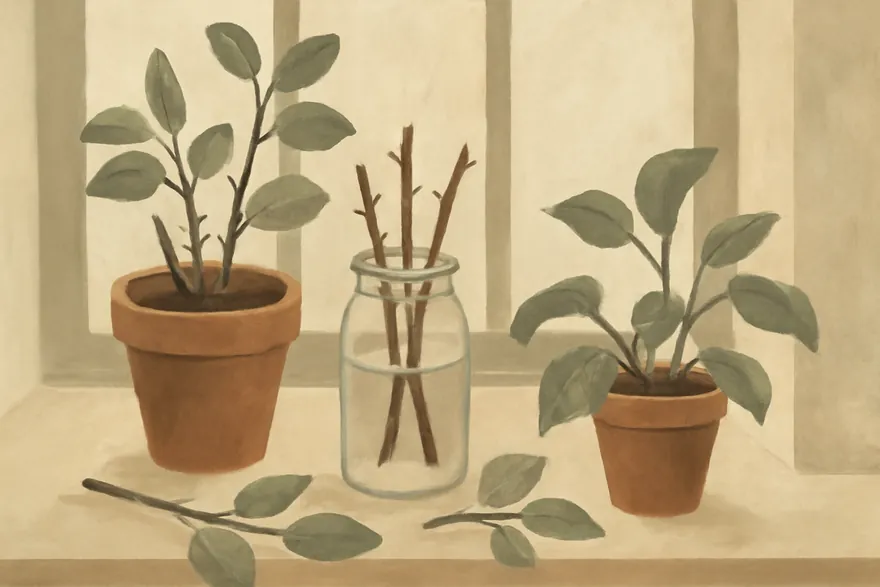
The Dormancy Window: Winter's Physiological Edge
Hardwood cuttings taken from roses in the depth of dormancy behave differently from the softwood or semi-ripe cuttings most propagation guides describe. By the time a rose has dropped its last leaf and weathered two or three hard frosts, with cane temperatures at or below minus 4 degrees Celsius, the plant has shifted its internal chemistry toward storage. Canes are loaded with stored carbohydrates and low in nitrogen, and the auxin-to-cytokinin balance that governs whether a cutting sprouts a shoot or initiates a root has swung toward rooting. This is the practical reason winter hardwood cuttings of roses often out-root cuttings taken from the same plant in June: there is no foliage draining water and sugars, no active shoot growth competing for the same carbohydrate pool, and the wood is fully lignified and resistant to the fungal collapse that kills a large share of humidity-tent softwood attempts.
The usable window runs roughly from late November through the end of January across USDA zones 5 to 7, or the equivalent chill period in similar temperate climates elsewhere. Cut too early, while some leaves still cling and sap is moving, and the carbon-to-nitrogen ratio has not shifted far enough. Cut too late, after prolonged deep freezes below minus 10 degrees Celsius, and canes can develop internal desiccation cracks that only become visible as blackened, hollow pith once the basal cut is made.
Selecting and Preparing the Wood
Take cuttings from the current season's growth only, choosing canes roughly pencil-thickness, about 6 to 10 millimeters in diameter. Discard the uppermost 5 to 8 centimeters of any cane, since that tip growth is rarely fully lignified even in January and rots before it roots. From the remaining mature wood, cut sections 20 to 25 centimeters long, each carrying three to five nodes.
- Make the basal cut at a shallow angle immediately below a node, where the concentration of cambial cells capable of forming callus and roots is highest.
- Make the top cut flat, about 1 centimeter above the uppermost node, to reduce the exposed surface prone to dieback.
- Strip any remaining leaves and thorns from the lower two-thirds of the cutting; leaves left on a hardwood cutting simply rot in storage rather than photosynthesizing anything useful.
- Wound the base by shaving a 2 to 3 centimeter sliver of bark from one side down to the green cambium. This single cut roughly doubles the callus ring available for root initiation compared with an unwounded basal cut, and it is the step most home propagators skip.
Work in the coldest part of the day if possible, and keep bundled cuttings out of direct sun and wind between the pruners and the rooting bed. Hardwood cuttings tolerate weeks of cold storage but only hours of drying wind before the cambium underneath the bark starts to shrink away from the wood.
Hormone Concentration: Why Dormant Wood Needs More
The single most common reason winter hardwood rose cuttings fail is treatment with the same rooting hormone concentration used for softwood cuttings earlier in the year. Lignified, dormant tissue is far less permeable and less physiologically responsive than the soft, actively dividing cells of a June cutting, so it needs a substantially stronger auxin dose to trigger the same root-initiation response.
For softwood and semi-hardwood rose cuttings, a rooting talc in the range of 1,000 to 3,000 ppm indole-3-butyric acid, commonly shortened to IBA, is typical. For dormant hardwood, that concentration is usually insufficient. Effective ranges reported for hardwood cuttings of woody ornamentals including roses run from 3,000 to 8,000 ppm IBA in talc form, equivalent to a 0.3 to 0.8 percent formulation. Growers using a liquid quick-dip rather than powder generally work at 4,000 to 5,000 ppm IBA, dipping only the basal 2 centimeters for no more than 5 seconds before sticking the cutting.
- Pure IBA is the more reliable auxin for hardwood rose wood. A small addition of naphthaleneacetic acid, or NAA, at roughly one part NAA to two or three parts IBA, can broaden the response on slower varieties, but NAA used alone or in excess tends to produce a swollen callus mass with few or no roots underneath it.
- Test any hormone product's potency before committing a full batch. IBA talc loses activity in humid storage and after about a year on the shelf, so a stored container that looks unchanged can still be delivering half its labeled concentration.
- More is not simply better. Concentrations above roughly 8,000 to 10,000 ppm on rose hardwood commonly cause basal blackening and bark splitting rather than faster rooting. Run a trial of 10 to 20 cuttings at the intended concentration before treating an entire winter's take.
Callusing, Planting, and Winter Aftercare
Two established routes take hardwood rose cuttings from hormone treatment to rooted plant, and the choice mostly comes down to climate and how much bed space is available.
Direct field sticking
In climates where the soil rarely freezes solid for more than a few weeks, cuttings can go straight into a nursery row: buried two-thirds of their length into well-drained sandy loam, spaced 10 to 15 centimeters apart, and mulched with about 5 centimeters of straw or bark to buffer frost heave. Rooting is slow and largely dictated by soil temperature; meaningful root initiation stalls below about 7 degrees Celsius soil temperature, so visible root development usually waits until late winter or early spring even though the cutting was stuck in December.
Bundle-and-callus storage
In colder climates, tie treated cuttings into bundles of 10 to 20, basal ends aligned, and store them basal-end-up in a box of moist sand or peat held at 4 to 7 degrees Celsius for 3 to 6 weeks before planting out. Keeping the basal end slightly warmer than the tip favors callus formation over premature bud break. Cuttings should show a visible callus ring, a pale, rounded swelling at the base, before they go into a cold frame or nursery bed.
Where equipment allows it, differential-temperature rooting improves results further: a soil-heating cable or bottom-heat mat keeps the basal end at 18 to 21 degrees Celsius while the top of the cutting stays cold, ideally below 4 degrees Celsius. This forces the cutting to build roots before the dormant buds break, rather than the reverse, which is the single most common cause of hardwood cutting failure overall: a cutting that leafs out in a warm room before it has any roots to support the new growth, exhausting its stored carbohydrate reserve in the process.
What to Expect, Variety by Variety
Hardwood cuttings are not a universal technique across the genus, and honesty about that saves a winter's work from ending in disappointment. Vigorous own-root types, including ramblers, species roses, and rootstock selections such as Rosa multiflora, Rosa canina, and Rosa rugosa, root reliably from hardwood cuttings, with well-run batches commonly reaching 60 to 80 percent success. Many modern hybrid teas, floribundas, and other cultivars bred for decades to be propagated by budding onto rootstock root far less willingly from hardwood cuttings; success rates of 15 to 40 percent are typical, and a handful of popular modern cultivars are difficult enough from hardwood that commercial growers do not bother, relying on budding instead.
- Patent status matters before starting: many modern cultivars are protected by plant patents or plant variety rights, and propagating a protected variety for sale or distribution without a license is a real legal exposure, not a technicality. Cuttings for personal, non-commercial use are typically permitted, but the specific patent terms are worth checking first.
- Own-root plants grown from hardwood cuttings are usually smaller and slower to establish in their first two seasons than a budded plant of the same variety, but they carry no graft union to fail and will not produce rootstock suckers, an advantage that compounds over the plant's lifetime.
- A blackened, soft, or hollow base at the point where a callus is expected is not dormancy; it is rot, usually from excess moisture or an over-strength hormone treatment, and that cutting will not recover.
- A cutting that remains green and firm but shows no callus swelling by week 8 is unlikely to root that season. Some hardwood roses genuinely take a full year, calloused through one winter and rooting only in the following one.
Quick comparison table for: Propagating Roses from Hardwood Cuttings in Winter: Timing and Hormone Concentration for Dormant Wood
| Section | What to check | How to use it |
|---|---|---|
| The Dormancy Window: Winter's Physiological Edge | Match the conditions and warning signs in this section | Use as a quick practical checklist |
| Selecting and Preparing the Wood | Match the conditions and warning signs in this section | Use as a quick practical checklist |
| Hormone Concentration: Why Dormant Wood Needs More | Match the conditions and warning signs in this section | Use as a quick practical checklist |
| Callusing, Planting, and Winter Aftercare | Match the conditions and warning signs in this section | Use as a quick practical checklist |
Questions and answers
Why do rose hardwood cuttings taken in winter often perform better than softwood cuttings?
In deep dormancy the rose has shifted to stored carbohydrates and lower nitrogen, and the auxin-to-cytokinin balance favors roots over new shoots. The wood is fully lignified and has no active leaf competition for water and sugar, so winter cuttings can be more stable than softwood attempts that are exposed to decay in humidity and heat.
What hormone levels and handling should be used for dormant hardwood rose cuttings?
Dormant hardwood needs stronger auxin than softwood: typically 3,000 to 8,000 ppm IBA in talc, or 4,000 to 5,000 ppm in a 2-centimeter quick dip for up to 5 seconds. Above 8,000 to 10,000 ppm can cause blackening and bark splitting, and only the basal end should be treated before sticking.