Propagating Spring Perennials from Basal Cuttings: Timing and Fungal Prevention
The Narrow Window: Why Shoot Emergence Sets the Clock
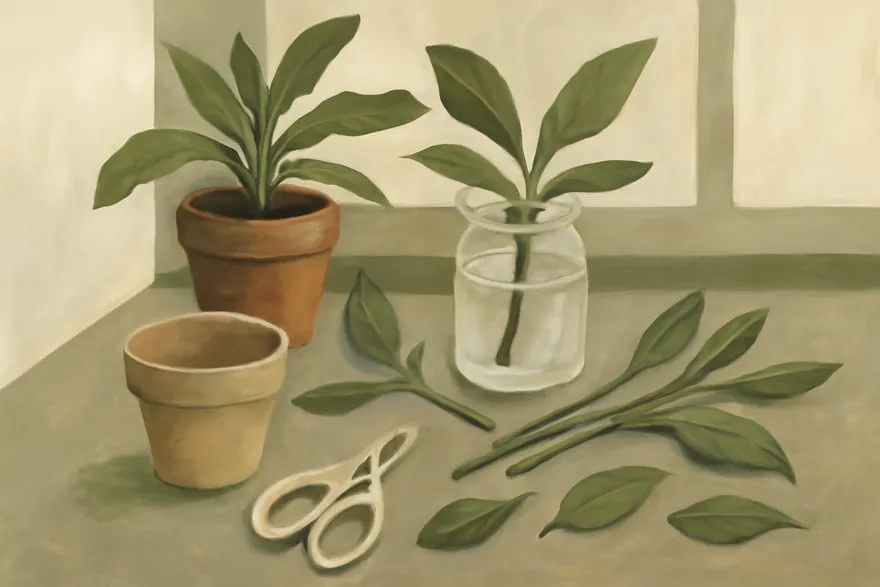
Basal cuttings are taken from new shoots pushing directly off the crown or rootstock of a herbaceous perennial in early spring, before those shoots elongate into flowering stems. The technique works on genera such as Delphinium, Lupinus, Phlox paniculata, Chrysanthemum, Helenium, and Aster novi-belgii, and it depends on timing more than any other single factor. Shoot tissue at emergence is unlignified, carries stored carbohydrate reserves from the overwintering crown, and its cambial cells divide quickly enough to form callus and root initials within days rather than weeks.
That advantage disappears fast. Once a shoot passes roughly 15 centimetres, internodes begin to elongate, the stem diameter thins, and in hollow-piped genera like delphinium and lupine the pith cavity opens up — a direct entry point for Pythium and soft-rot bacteria once the cutting is under mist. Track soil temperature at 5 centimetres depth with a probe rather than guessing from air temperature: growth typically restarts once soil holds 5–7 degrees Celsius for three to five consecutive days. From that point, start daily crown inspections, because the cutting-ready window usually runs only 10 to 20 days before shoots outgrow the ideal harvest size.
Reading the Shoot: What “Ready” Actually Looks Like
Visual size is a poor proxy on its own; feel and structure matter more. Before cutting, check each shoot against the following:
- Base solidity: pinch the lower few centimetres between thumb and finger — it should feel firm and solid, not spongy or hollow.
- Stem diameter: roughly pencil-lead to pencil thickness, about 3 to 6 millimetres; thinner growth roots poorly, thicker growth is often already past the juvenile stage.
- Leaf stage: two to four unfurled leaves or leaf pairs, with no visible flower bud forming at the tip.
- Shoot length: 7 to 12 centimetres for most genera; delphinium and lupine are best harvested at the shorter end of that range, around 7 to 10 centimetres, because their pith cavity opens early.
Harvest in the early morning while shoots are fully turgid, and avoid cutting within a few hours of rain or overhead irrigation. Surface moisture on the crown at harvest time is one of the more overlooked ways fungal inoculum gets carried straight into the propagation tray.
Cutting Technique and Immediate Handling
Use a blade sanitized in 70 percent isopropyl alcohol or a 10 percent bleach solution, with a 30-second dwell time, and re-sanitize between plants — not just between cultivars. For genera prone to basal rot, take the cutting with a thin sliver of crown tissue attached, known as a heel; the exposed crown tissue calluses over faster than a flat cut and gives the rooting hormone a larger absorptive surface.
- Cut the shoot away from the crown, retaining a small heel where the genus warrants it.
- Trim to two nodes, remove the lowest leaf pair, and keep the cutting in a shaded, covered tray — not standing in open water for more than about 15 minutes, which encourages bacterial buildup at the cut surface.
- Dip the base in IBA rooting hormone, either a 1,000 to 3,000 ppm liquid or a 0.1 to 0.3 percent talc formulation, tapping off excess powder.
- Stick the cutting the same day it was harvested. Holding a batch overnight, even refrigerated, measurably raises basal rot incidence in trials growers commonly cite for delphinium and lupine.
The Fungal Prevention Protocol
Basal cuttings fail more often from crown and stem rot than from failure to root at all, and the two are connected: any delay in callus formation extends the window during which Pythium, Rhizoctonia solani, and Botrytis cinerea can colonise the wound. The protocol below is aimed at shortening that window and reducing inoculum load, not at rescuing cuttings that are already symptomatic.
- Fresh medium only. Use a soilless mix of perlite and vermiculite, or perlite and coarse sand, at a pH of 5.5 to 6.2. Reused mix and garden soil carry over Rhizoctonia and Pythium propagules from prior batches; discard spent medium rather than topping it up.
- Preventive biofungicide drench. Some propagators drench the mix with a Bacillus subtilis or Trichoderma-based biofungicide before sticking cuttings. This is a preventive measure only — it does not reverse rot once the base has already blackened.
- Bottom heat, not just top heat. Hold the medium at 18 to 21 degrees Celsius. Faster callusing outruns pathogen establishment; cold, wet media is the single condition most associated with basal blackening in cool spring propagation houses.
- Ventilate the dome daily. Ten to fifteen minutes of venting each day prevents condensation from pooling on foliage, which is a primary driver of Botrytis outbreaks under humidity domes.
- Water the medium, not the leaves. Direct water to the base of the mix. After the first week, let the surface dry to the touch between waterings rather than keeping it saturated.
- Inspect twice daily for the first 10 to 14 days. Any cutting showing blackening, softening, or a sour smell at the base should be pulled and discarded immediately — not left in place hoping it recovers, since it becomes an inoculum source for neighbouring cells.
- Space cuttings so foliage doesn’t touch. Crowding restricts airflow between plants and is a common, easily fixed contributor to Botrytis spread across a tray.
Weaning, Transplant Timing, and Honest Limits
Rooting speed varies widely by genus: chrysanthemum basal cuttings typically root in 10 to 14 days, phlox paniculata in 2 to 3 weeks, and delphinium or lupine in 3 to 4 weeks. Test for rooting with a very gentle tug rather than pulling the cutting to inspect it; resistance plus new leaf growth is a reliable enough signal. Once roots are established, wean the cuttings off the humidity dome gradually over 5 to 7 days by increasing ventilation before removing it entirely, then pot up into individual cells as soon as the root system fills the plug.
It is worth being direct about what this protocol can and cannot fix. Rooting hormone and rigorous sanitation cannot compensate for a shoot harvested too late, once the stem has hollowed and lignified. Genus also matters more than technique in some cases: lupine remains erratic even under an ideal protocol, with growers commonly reporting success rates around 50 to 60 percent, against 80 to 90 percent for chrysanthemum or phlox taken at the right stage. And not every perennial that produces basal growth is a good candidate for cutting propagation at all — some, particularly those with fibrous, congested crowns, are more reliably increased by division than by basal cuttings regardless of how carefully the harvest and sanitation steps are followed.
Quick comparison table for: Propagating Spring Perennials from Basal Cuttings: Timing and Fungal Prevention
| Section | What to check | How to use it |
|---|---|---|
| The Narrow Window: Why Shoot Emergence Sets the Clock | Match the conditions and warning signs in this section | Use as a quick practical checklist |
| Reading the Shoot: What “Ready” Actually Looks Like | Match the conditions and warning signs in this section | Use as a quick practical checklist |
| Cutting Technique and Immediate Handling | Match the conditions and warning signs in this section | Use as a quick practical checklist |
| The Fungal Prevention Protocol | Match the conditions and warning signs in this section | Use as a quick practical checklist |
Questions and answers
When is the best time to take spring perennial basal cuttings?
Take cuttings from new shoots pushing from the crown in early spring at shoot emergence, before they become flowering stems. Track 5 centimetres soil temperature with a probe and begin checks once it stays at 5 to 7 degrees Celsius for three to five consecutive days. The ready window is short, usually 10 to 20 days, and visual size alone is not enough: shoots should be firm at the base, with two to four unfolded leaves, and about 7 to 12 centimetres long (delphinium and lupine are best around 7 to 10 centimetres).
How can I reduce fungal losses during cutting collection and handling?
Sanitize the blade before use in 70 percent isopropyl alcohol or a 10 percent bleach solution with a 30-second dwell, and re-sanitize between plants. Take a thin heel for rot-prone genera, trim to two nodes, remove the lowest leaf pair, and keep cuttings in shade without standing in open water longer than about 15 minutes. Use fresh perlite-based medium, provide bottom heat at 18 to 21 degrees Celsius, ventilate daily 10 to 15 minutes, water the base, and inspect twice daily for the first 10 to 14 days, discarding any with blackening, softening, or sour smell.